
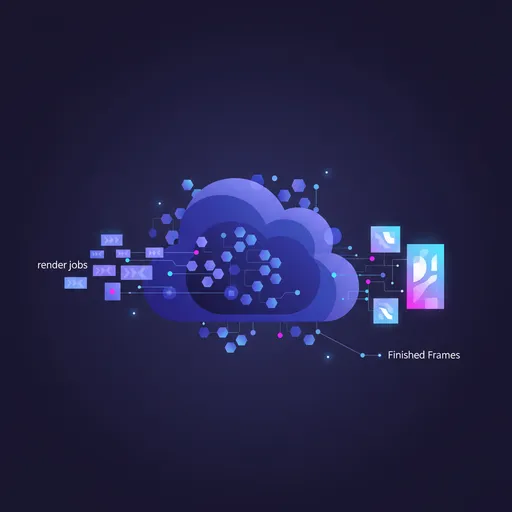
Cloud Rendering Definition
Cloud rendering is the use of remote, on-demand server infrastructure to process computationally intensive video tasks such as VFX rendering, encoding, and transcoding without requiring local hardware investment.
Why cloud rendering matters
On-premises render farms require substantial capital investment — hardware procurement, power and cooling infrastructure, network connectivity, maintenance, and periodic upgrades. This investment must be sized for peak demand, meaning expensive hardware sits idle during off-peak periods. Cloud rendering converts this capital expense into an operational one, providing virtually unlimited processing capacity available on demand and billed by usage.
The scalability of cloud rendering is transformative for certain workflows. A project with a tight deadline can spin up hundreds of render nodes simultaneously, completing in an hour what would take a week on local hardware. When the deadline passes, those resources are released and costs drop to zero. This elasticity is impossible with fixed on-premises infrastructure.
For distributed teams — increasingly common in post-production — cloud rendering provides shared processing capacity accessible from anywhere. A colorist in London, a VFX artist in Vancouver, and an editor in Tokyo can all submit jobs to the same cloud render farm without shipping data between physical locations.
Best practices
Calculate the true cost comparison between cloud and on-premises rendering including all factors: hardware depreciation, power, cooling, maintenance staff, floor space, and utilization rate. Cloud rendering is not always cheaper — teams with consistent high-volume rendering may find owned hardware more economical. The calculus favors cloud for bursty, unpredictable workloads and on-premises for steady-state demand.
Design your pipeline for data locality. Cloud rendering requires source assets to be accessible from cloud nodes, meaning either uploading assets before rendering or maintaining cloud-proximate storage. Transfer time and costs for moving large video assets to and from cloud providers can dominate the total cost if not managed carefully.
Implement cost controls and monitoring from day one. Cloud resources are easy to provision and easy to forget about. Runaway render jobs, forgotten instances, and unmonitored auto-scaling can produce surprising bills. Set budgets, alerts, and automatic shutdowns to prevent cost overruns.
How ShotAI relates
ShotAI's local-first architecture ensures your video search and discovery capabilities remain fast and available regardless of cloud rendering status, while helping identify the specific assets needed for cloud-submitted render jobs.
Related Terms
Render Farm
A render farm is a networked cluster of computers that distributes computationally intensive video rendering, VFX processing, and export tasks across multiple machines to dramatically reduce processing time..
Transcoding
Transcoding is the process of converting video from one codec, resolution, or container format to another, typically to optimize footage for a specific stage of production such as editing, delivery, or archival..
Video Compression
Video compression is the application of algorithms that reduce video file size by eliminating redundant or perceptually irrelevant data, balancing storage efficiency against visual quality preservation..
Written by the ShotAI team. Last updated May 2026.