
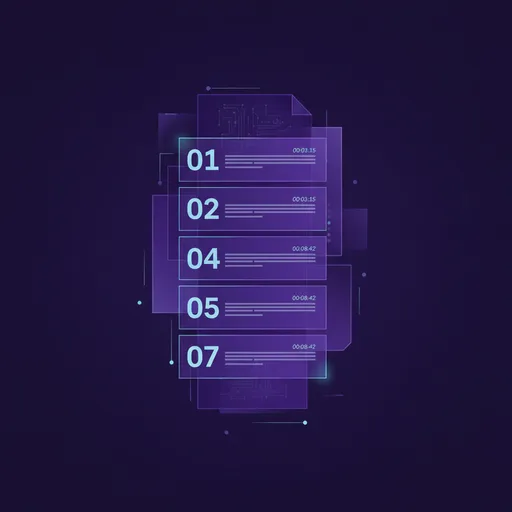
Edit Decision List Definition
An edit decision list (EDL) is a structured document that records every edit in a sequence — including source reels, timecodes, transition types, and durations — enabling a final cut to be precisely recreated from original source material.
Why edit decision list matters for video teams
An EDL is fundamentally a recipe for rebuilding an edit. It lists each event (cut, dissolve, wipe) with the exact source timecodes and record timecodes needed to assemble the sequence from scratch. This makes EDLs essential for workflows where editing happens in one system but finishing (color grading, online editing, mastering) happens in another.
The concept dates back to linear tape editing, where an EDL was the only way to recreate an edit without starting over. In modern workflows, EDLs remain vital for conforming — the process of rebuilding an offline edit using full-resolution original media in a finishing system. A colorist receiving an EDL can automatically assemble the sequence in DaVinci Resolve using camera-original files, even though the editor worked with proxies in Premiere Pro.
EDLs also serve as archival records. Years after a project completes, an EDL combined with original source material allows the exact recreation of the final cut. This matters for versioning (creating a new cut for a different market), remastering (applying new color science to old edits), and legal documentation (proving exactly what was broadcast).
Best practices for edit decision list
Export EDLs at every major milestone — rough cut, fine cut, picture lock, and final master. Each represents a recoverable state of the project. Store EDLs alongside project files and source material in your archive. They are small text files that provide enormous value relative to their storage cost.
Understand the limitations of standard EDL formats. CMX 3600, the most widely supported format, handles only one video track and basic transitions. Complex timelines with multiple video layers, speed changes, or advanced effects cannot be fully represented. For complex projects, supplement EDLs with AAF or XML exports that capture the full timeline structure.
Verify EDL accuracy after export by conforming in your target system. Do not assume the export is perfect — subtle issues with frame rate conversion, timecode interpretation, or transition handling can introduce single-frame errors that become visible in the final product. A test conform catches these before they reach the client.
How ShotAI relates to edit decision list
ShotAI's timecode-accurate indexing means that EDL references can be cross-referenced against the search index, allowing teams to trace any moment in a final cut back to its original source and find alternative takes from the same shoot.
Related Terms
Timecode
Timecode is a standardized numerical labeling system that assigns a unique hours:minutes:seconds:frames address to every frame of video, enabling precise identification, synchronization, and editing of specific moments..
Non-Linear Editing
Non-linear editing (NLE) is a digital video editing method that allows instant random access to any frame in the source material, enabling editors to assemble, rearrange, and modify sequences in any order without destructive changes to original files..
Rough Cut
A rough cut is the first assembled version of an edited video that establishes the overall structure, scene order, and approximate timing before detailed refinement of pacing, transitions, audio, and visual effects..
Written by the ShotAI team. Last updated May 2026.