
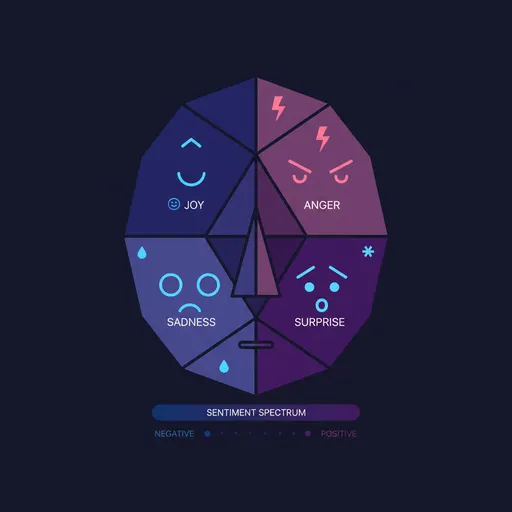
Emotion Detection Definition
Emotion detection in video is an AI analysis technique that interprets facial expressions, body language, vocal tone, and contextual cues to infer the emotional states of people appearing on screen.
Why emotion detection matters for video teams
Video's power lies in its ability to convey emotion. The perfect interview moment is not defined by what was said but by how it was said — the genuine smile, the thoughtful pause, the passionate emphasis. Editors spend enormous time scrubbing through footage looking for these emotional peaks, moments where authentic feeling breaks through and connects with audiences.
Emotion detection automates the identification of these moments. Instead of reviewing hours of interview footage to find the 30 seconds where the subject's passion genuinely shows, an editor can search for moments of high emotional intensity. For documentary filmmakers, corporate video producers, and anyone working with human subjects, this capability directly addresses their most time-consuming editing challenge.
Beyond individual moment finding, emotion detection enables analysis of emotional arcs across longer content. A feature documentary can be mapped by emotional trajectory — identifying where the story builds tension, delivers resolution, or provides relief. This structural analysis helps editors evaluate pacing and emotional rhythm at a macro level.
Best practices for emotion detection
Treat emotion detection results as suggestions, not ground truth. Facial expression analysis has well-documented limitations — cultural differences in expression, individual variation, and context-dependency mean that AI confidence scores should inform human review rather than replace it. Use detection to narrow your search, then apply human judgment for final selection.
Be thoughtful about privacy and consent when implementing emotion detection. Some jurisdictions regulate biometric analysis including facial expression interpretation. Ensure your use case aligns with applicable regulations and that subjects have appropriate awareness of how their footage is being analyzed.
Combine emotion detection with audio analysis for more reliable results. A person who appears stoic visually may reveal emotion through vocal tremor, pacing changes, or word choice. Multimodal emotion analysis that considers both visual and audio signals produces more nuanced and accurate results than either modality alone.
How ShotAI relates to emotion detection
ShotAI's multimodal understanding captures emotional qualities in indexed footage, helping editors surface powerful human moments that connect with audiences without manually reviewing hours of interviews and performance footage.
Related Terms
Action Recognition
Action recognition is an AI capability that identifies and labels specific physical actions, gestures, and movements occurring in video — such as running, handshaking, cooking, or typing — by analyzing temporal patterns across sequences of frames..
Content-Aware Search
Content-aware search is a retrieval method that finds media based on analysis of what the content actually contains — objects, actions, speech, text, and visual elements — rather than relying on filenames, folder locations, or manually applied metadata..
Multimodal Embeddings
Multimodal embeddings are AI-generated mathematical representations that capture meaning across multiple types of content simultaneously — including visual frames, spoken audio, on-screen text, and music — within a unified vector space..
Written by the ShotAI team. Last updated May 2026.